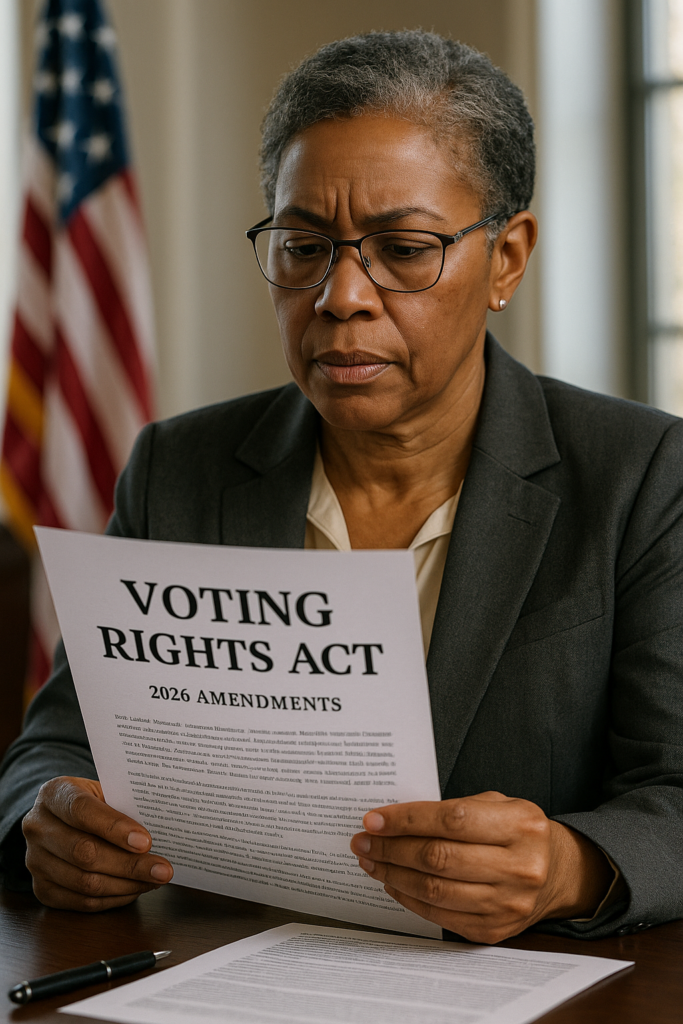
The Voting Rights Act 2026 amendments introduced new requirements around voter registration, including enhanced citizenship verification and updated federal guidelines. This guide breaks down what changed, who is affected, and exactly what steps voters and registrars must now follow to comply with federal law.
Understanding the Voting Rights Act 2026
The Voting Rights Act is a foundational U.S. law that protects citizens from discrimination in voting. The 2026 amendments aim to address concerns about voter eligibility and election integrity by implementing stricter registration processes and oversight. The changes come through congressional action, a major executive order, and new legislation called the SAVE America Act (Congressional Record Index 2026, SAVE America Act).
Major Forces Behind the Amendments
- Congress: Deliberated and passed the core amendments, updating provisions of the Voting Rights Act and Voter Registration Act.
- Executive Branch: President signed Executive Order 14399 to direct agencies on implementation and reinforce citizenship requirements.
- Legislation: SAVE America Act clarifies specific documentation and procedures for voter eligibility.
Key Changes in the 2026 Voting Rights Act
- Mandatory Proof of Citizenship: Registrants must present approved documents.
- Federal Verification System: States and territories are directed to utilize federal databases to verify citizenship status.
- State Implementation Deadlines: Specific deadlines for states to update registration systems.
These changes apply to all federal elections and set minimum standards that states may supplement, but not undercut (Executive Order 14399).
What Proof of Citizenship Means for Voters
You will need to provide evidence of U.S. citizenship when registering to vote for a federal election. Acceptable documents generally include U.S. birth certificates, U.S. passports, naturalization certificates, or tribal documents as listed by the SAVE America Act. Each state will publish a list of acceptable forms based on this federal minimum (SAVE America Act).
Sample Checklist: Required Steps for New Voters
| Step | Action | Notes |
|---|---|---|
| 1 | Complete voter registration form | Available at election offices and online |
| 2 | Provide proof of U.S. citizenship | One approved document required |
| 3 | Submit form and documentation | May be in person, mail, or secure upload |
| 4 | Verification by election officials | States use federal database checks |
| 5 | Confirmation of registration | Official notice sent to applicant |
Who Is Most Affected by the 2026 Amendments?
- First-time Voters: Must provide citizenship proof during registration.
- Voters Updating Registration: Name or address changes now require re-validation of citizenship.
- Local Election Offices: Responsible for updating processes and training staff on new federal systems.
State vs. Federal Roles
States must comply with these federal minimums but can choose to add their own requirements or auditing procedures. For details or exceptions in your state, the Secretary of State’s office is the best resource. The federal government will periodically review compliance and can intervene if states fail to meet the new standards (Congressional Record Index 2026).
Illustrative example: Verifying Citizenship During Registration
Assumptions: Jane Doe, a U.S.-born citizen, wants to register to vote. She has a valid U.S. passport.
- Jane goes to her state’s election website and fills out the federal voter registration form.
- She uploads a scan of her U.S. passport.
- The local registrar reviews her submission and checks Jane’s information against the federal verification database.
- Jane receives a confirmation by mail within two weeks.
Challenges and Considerations
- Document Access: Some citizens, such as elderly individuals or those born outside hospitals, may not have ready access to approved documentation and may need to request replacements.
- Processing Times: Verifying documents may extend registration timelines compared to past years.
- Existing Voters: Many existing registered voters are not required to resubmit proof unless updating their information.
Where to Get Help
- State Election Offices: Primary source for documentation lists and deadlines.
- Official Federal Portal: For updates on federal requirements.
- Nonprofit Voter Assistance: Advocacy groups offer guidance and help obtaining necessary documents.
Practical Next Steps for Voters
- Check your current voter registration status and confirm whether you need to take further action under the new law.
- Locate and safeguard your citizenship documents in advance of upcoming registration deadlines.
- Contact your election office with any questions about acceptable forms or procedures.
For additional context, refer to the official legislative documents: Congressional Record Index 2026, Executive Order 14399, and the SAVE America Act.
Sources and further reading
- CRI2026 – VOTING RIGHTS ACT – CRI-2026-VOTING-RIGHTS-ACT | Document in Context | GovInfo
- Ensuring Citizenship Verification and Integrity in Federal Elections – The White House
- Safeguard American Voter Eligibility Act – Wikisource, the free online library
Related guide
Understanding the Hidden Costs of Homeownership — Save $4,000