If you struggle to accomplish meaningful progress in short work bursts, microproductivity techniques can help you turn moments of digital downtime into real achievements. Microproductivity breaks your tasks into smaller pieces, matching your busy schedule, so you can make measurable improvements even with limited time.
What Are Microproductivity Techniques?
Microproductivity techniques are approaches that decompose large tasks into small, actionable microtasks. This method allows you to take advantage of short windows of time—”micromoments”—to maintain or advance productivity regardless of interruptions or schedule constraints. The practice is not tool-specific; it’s about changing how you structure and schedule your work cycles, often making digital work more manageable and less overwhelming.
For example, instead of writing an entire report in one sitting, you might divide it into microtasks: outline the segments, draft a section introduction, edit a single paragraph, or brainstorm bullet points. This strategy is supported by research from Microsoft, which found that leveraging micromoments leads to steady progress without the need for uninterrupted hours of focus (Microsoft Research).
Why Use Microproductivity Techniques?
- Match your workflow to a busy, unpredictable schedule
- Reduce overwhelm by focusing on one microtask at a time
- Prevent task stagnation by making continuous, incremental progress
- Re-engage quickly after interruptions
Microproductivity can especially benefit digital workers, students, or anyone whose day is fragmented into small, usable periods.
Choosing Microtasks: A Practical Framework
Start by selecting a complex task you often avoid due to time constraints. Break it into standalone microtasks, each completable in 5-15 minutes. Each microtask should have a clear goal, such as “convert section to bullet points” or “search for one relevant source.” This modular approach is at the heart of microproductivity (Microsoft Research).
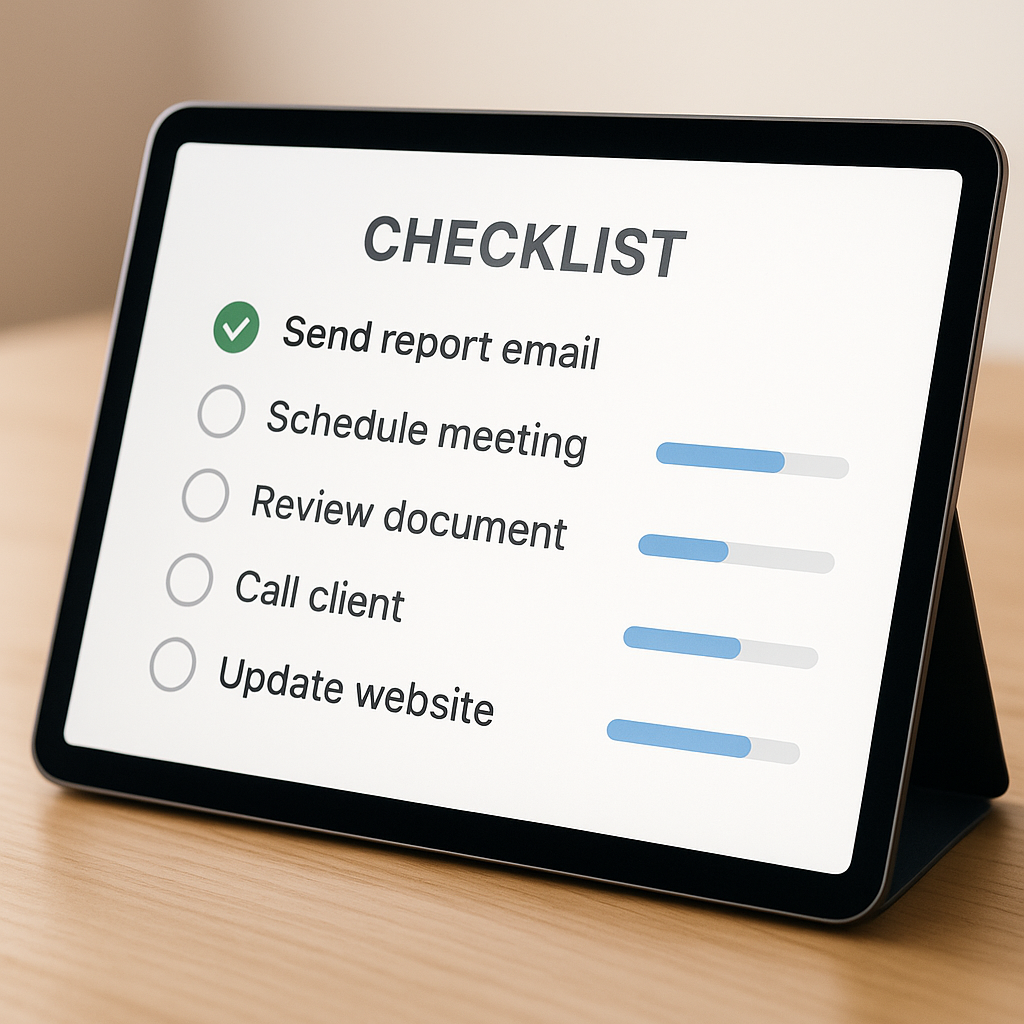
Checklist: Designing Effective Microtasks
| Step | Action | Outcome |
|---|---|---|
| 1 | Define the big task | “Write team report” |
| 2 | Break into sub-tasks | Outline, research, draft, edit |
| 3 | Chunk each sub-task into microtasks | “Edit one paragraph,” “Find one quote” |
| 4 | Prioritize by quickest wins | Start with “Draft introduction” |
| 5 | Track progress digitally | Check off completed microtasks |
Tools and Digital Habits for Microproductivity
Your phone, laptop, or even a notes app can enable microproductivity. For digital professionals like programmers, research shows the use of specialized systems that segment work—such as “Mercury,” which breaks coding tasks into mobile-friendly microtasks to be addressed on-the-go. This helps users make continuous progress and allows for quick resumption of major work at their primary workstation (Mercury – Experts@Minnesota).
- Task List Apps: Use tools that let you easily rearrange and check off small steps (e.g., Todoist, Microsoft To Do).
- Notes Apps: Quick-capture anything—a to-do, idea, edit—for your next microtask.
- Reminders: Set calendar blocks or timer reminders for your designated micromoments.
- Cloud Sync: Ensure your work is available across devices—helping you resume microtasks anywhere.
Focus on building the habit of asking: “What’s the smallest useful step I can take now?” Repeat this process, and watch as your larger goals advance.
Illustrative Example: Applying Microproductivity to Report Writing
Case: Suppose you need to write a 1,500-word project report in a busy week with only scattered, short periods available.
- Assumption: You have 5 sessions per day, each about 10 minutes.
- First, outline the report (10-minute session).
- Second, for each session, pick a targeted microtask:
- Session 2: Draft the introduction (10 min).
- Session 3: Add section headings (10 min).
- Session 4: Fill in bullet points under one heading (10 min).
- Session 5: Edit and refine previous text (10 min).
- Continue sequencing microtasks until each report section is filled out and edited.
Result: Instead of postponing the report, you finish it through 10-minute microtask bursts spread throughout the week—demonstrating measurable advancement each day.
Measuring Progress and Making Adjustments
Tracking the completion of microtasks is vital for sustaining motivation and evaluating your approach. Digital tracking (checklists, task management apps) makes it easy to visualize your progress. If certain microtasks are still taking longer than expected or feel too complex, further decompose them for even more manageable steps.
The U.S. Census Bureau’s research highlights that even at a larger scale, breaking down productivity data into smaller units—”establishment-level”—allows closer analysis and improvement, reinforcing the principle that incremental advances matter for overall goals (Collaborative Micro-Productivity Project).
Common Pitfalls and How to Avoid Them
- Over-chunking: Avoid splitting tasks so small they become trivial; each microtask must have clear, valuable output.
- Neglecting review: Schedule periodic reviews to reorder, adjust, or combine microtasks for flow and relevance.
- Losing sight of bigger goals: Regularly recap how each microtask ties into your main objective, ensuring continued alignment.
Quick Start: Five Microproductivity Habits to Try
- Every morning, break your top two tasks into microtasks.
- Use phone notes to jot down microtask ideas whenever they occur to you.
- Assign a microtask to every calendar gap of 10 minutes or more.
- Review your accomplishments weekly and refine your breakdown process.
- Sync your microtasks across devices to capture every micromoment, wherever you are.
For broader digital improvement, see guides like Mastering Digital Literacy for Families in 2026.
Next step: Pick one large digital task today, break it into at least three microtasks, and schedule each into a short digital break. Track your results for one week to experience the shift.