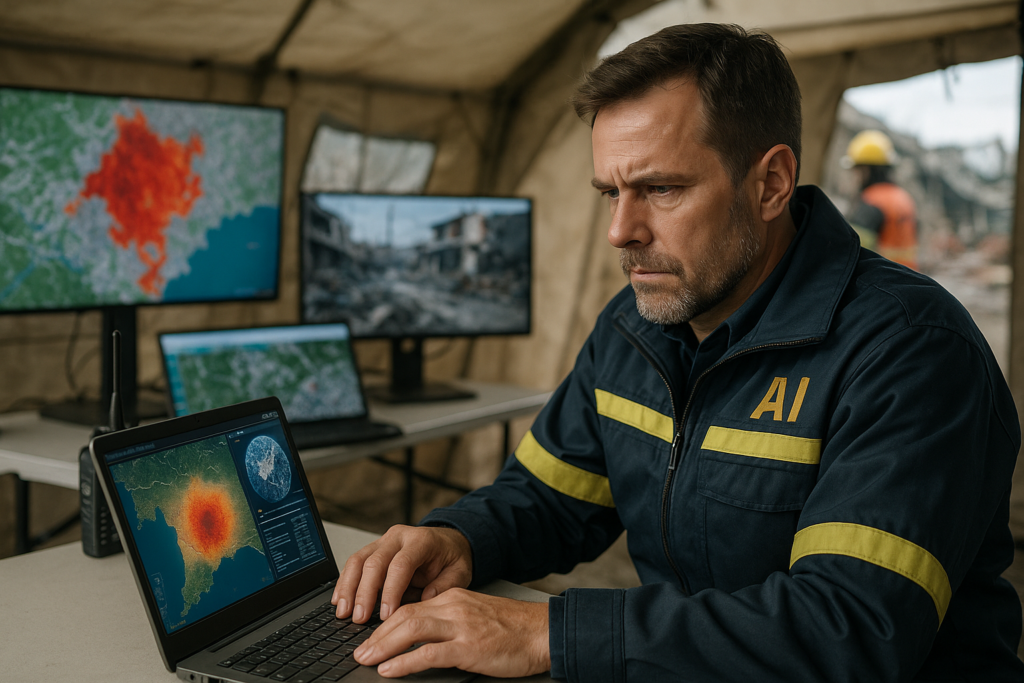
AI disaster response is transforming emergency management by enabling quicker, more precise decisions and faster damage assessment. This practical guide explains how AI technologies are being used to improve disaster scenarios, what steps are involved, and what decision-makers should know to take advantage of these advances.
Understanding AI in Disaster Response
Artificial Intelligence (AI) in disaster response means applying machine learning, computer vision, and data aggregation systems to rapidly gather, analyze, and act on complex information from multiple sources. This improves decision accuracy and speed during critical emergencies.
- Damage assessment: AI processes aerial/satellite images for rapid infrastructure analysis.
- Resource allocation: Algorithms help prioritize emergency services deployment.
- Information fusion: AI consolidates data from sensors, social media, and field inputs for decision-makers.
Key Actions and Technologies
Implementing AI disaster response typically involves these concrete steps:
- Data Collection: Gather real-time data from drones (sUAS), satellites, IoT sensors, and social feeds.
- Image Processing: Use computer vision models to assess damage severity and map hazards.
- Decision-Making Frameworks: Apply structured AI models, such as Enabler agent frameworks, to justify and prioritize actions.
Scientific Reports: Structured AI Decision-Making - Resource Deployment: AI systems recommend optimal placement and allocation of resources based on real-time assessments.
IEEE: Real-Time Emergency Management
Sample AI-Based Damage Assessment Workflow
- Small uncrewed aerial systems (sUAS) capture high-resolution images of affected areas within minutes after a disaster.
- AI/ML models, trained on thousands of post-disaster images, automatically identify damaged buildings and infrastructure.
AAAI: sUAS Imagery Assessment - Results are aggregated in a dashboard for instant review by emergency managers.
Decision Criteria for Adopting AI Solutions
Not every disaster response operation is equally suited to AI deployment. Consider these factors:
| Decision Factor | AI Advantage | Potential Limitations |
|---|---|---|
| Data Availability | Rapid, accurate analysis if ample real-time data exists | Performance drops if data is sparse or unreliable |
| Disaster Scale | Efficient for large, complex emergencies | Overhead may not justify use in small events |
| Resource Levels | Optimizes limited manpower and supplies | Requires trained personnel for operation and oversight |
| Ethical & Legal Oversight | Transparent frameworks can enhance public trust | Decisions must be explainable and justifiable |
Practical Applications: Recent Examples
- Autonomous Decision-Making: AI frameworks using Enabler agents and scenario-based models provide structured justification for prioritizing rescue operations and resource deployment, making decisions more transparent to operators.
Scientific Reports: AI Framework - Rapid Damage Surveys: AI-powered assessment systems processed images spanning hundreds of buildings within minutes during Hurricanes Debby and Helene, offering faster situational awareness compared to manual mapping.
AAAI: Disaster Assessments - Real-Time Data Fusion: Emergency platforms now integrate sensor streams, social media alerts, and satellite feeds through AI, reducing manual delays and improving information flow.
IEEE: Real-Time Management
Illustrative Example: AI-Assisted Building Assessment
Scenario: Following a major hurricane, emergency managers must prioritize shelter response based on building damage in a coastal city.
- Input: sUAS captures 1,000 aerial images; AI model can process about 23 images per minute (as reported for real-world deployment).
- Calculation: 1,000 images ÷ 23 images/minute ≈ 43.5 minutes total processing time.
- Outcome: Within under an hour, responders receive a prioritized map of building damage, streamlining decision-making and resource allocation compared to manual review.
This method scales as image coverage increases, provided processing capacity and network availability are maintained (see AAAI source).
Limitations and Considerations
- Data reliability: AI systems are only as accurate as their input data; poor weather or obstructed images can hinder performance.
- Transparency: Using decision frameworks with explainable logic (e.g., Enabler agents) helps ensure AI recommendations are auditable and trusted.
Scientific Reports - Ethical Oversight: Automated decisions in safety-critical situations require robust oversight for public accountability.
- Operational readiness: Skilled teams must be available to interpret and act on AI output in real time.
Checklist: Steps to Integrate AI into Disaster Response
- Evaluate data sources and coverage for the target region.
- Select and validate AI models trained on relevant disaster scenarios.
- Establish clear, auditable frameworks for decision-making.
- Prepare personnel to interpret and act on AI-generated insights.
- Monitor results and refine models as new challenges emerge.
Next step: If your organization is considering adopting AI for disaster response, start by reviewing your data capabilities, then pilot a use case such as automated damage assessment or resource allocation to evaluate the benefits and constraints firsthand.
Sources and further reading
- Structured AI decision-making in disaster management | Scientific Reports
- Deploying Rapid Damage Assessments from sUAS Imagery for Disaster Response | Proceedings of the AAAI Conference on Artificial Intelligence
- AI for Disaster Response: Developing Intelligent Systems for Real-Time Emergency Management | IEEE Conference Publication | IEEE Xplore