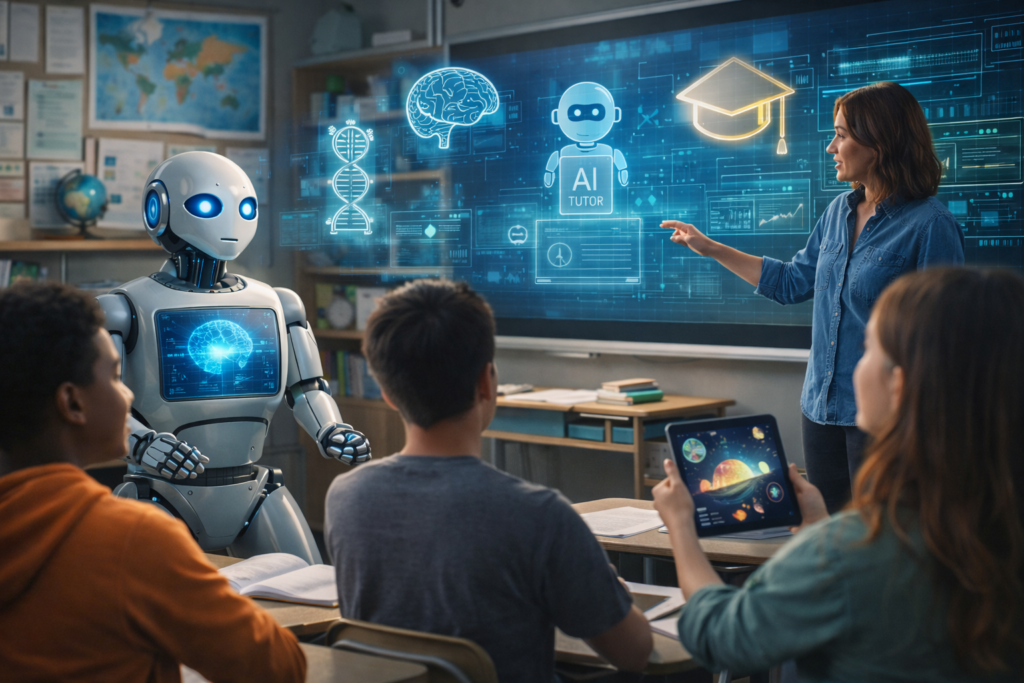
AI in education brings powerful opportunities and serious risks. It offers tools for tailoring learning and automating assessments, but challenges like bias, privacy, and loss of student agency must be critically evaluated. Use this evidence-based guide to weigh these trade-offs and support ethical, effective educational choices around AI.

The Promise and Peril of AI in Education
AI technology—spanning chatbots, adaptive tutors and automated grading—has entered classrooms and campuses around the world. Many educators and learners use AI models to generate practice questions, receive feedback, and brainstorm ideas. Yet, the integration of AI also brings concerns about data privacy, algorithmic fairness, academic integrity, and the evolving role of teachers. A careful, evidence-focused approach helps schools and families navigate these benefits and pitfalls (Council of Europe).
Key Benefits of AI in Education
- Personalized learning pathways: AI can adapt content, pace, and assessment to each student’s needs, enhancing engagement and outcomes.
- Efficient assessment and feedback: Automated systems enable quick, formative feedback and can scale to large numbers of students.
- Access to virtual tutoring: Natural language models (like ChatGPT) provide students with immediate, 24/7 support, explaining complex topics or revising written work.
- Support for teachers: AI can help with lesson planning, assignment generation, and identifying learning gaps.
These advances are especially visible in recent pandemic years, where remote and hybrid learning increased demands for technological support (Council of Europe). The promise of individualized, scalable support has motivated many institutions to experiment with AI tools.
Main Pitfalls and Ethical Challenges
- Data privacy: AI systems may process sensitive student information, raising risks under data protection laws.
- Algorithmic bias: If not managed carefully, AI may amplify bias in assessments, feedback or resource allocation—especially for marginalized groups.
- Academic integrity: Unchecked use of AI to generate essays or solve tasks can undermine learning goals and fair evaluation.
- Loss of agency: Over-reliance on AI may erode students’ initiative, critical thinking, or the educator’s role as a guide (Karpouzis).
- Inaccuracy and hallucination: Some AI tools generate unreliable or false information, requiring careful fact-checking (Sok & Heng).
The balance between benefit and risk depends on how schools, families, and students select, implement, and oversee these tools.
Checklist: Evaluating AI Tools in Education
| Criterion | Questions to Ask |
|---|---|
| Privacy | Does the tool comply with data protection laws? Who can access student data? |
| Transparency | Can teachers and students understand how the AI system makes decisions? |
| Bias Mitigation | What evidence exists that the tool avoids unfair bias? Are results regularly reviewed? |
| Pedagogical Alignment | Does the tool support—not replace—core learning goals and teacher guidance? |
| Accuracy | How often does the AI provide accurate versus spurious information? Are claims easily checked? |
| Academic Integrity | Are there safeguards to prevent misuse for plagiarism or cheating? |
| Student Agency | Does the tool encourage initiative, or just present answers? |
Steps Toward Ethical, Effective Use
- Critically assess AI offerings. Before adopting AI platforms or services, use the above checklist and consult trusted reviews.
- Engage stakeholders. Involve students, teachers, and parents in choices and feedback around AI in the classroom.
- Set clear usage policies. Define acceptable and prohibited uses of AI, especially concerning assessments and academic integrity.
- Invest in teacher training. Equip teachers to guide students in both using and critically evaluating AI tools.
- Monitor and iterate. Collect ongoing feedback, measure outcomes, and adjust usage as needed.
For instance, many institutions recommend using AI as a brainstorming assistant, not a substitute for original writing or critical analysis (Sok & Heng).
Illustrative Example: Adopting an AI Tutoring Tool
Assumptions: A high school is considering an adaptive AI learning tutor for mathematics.
- The school forms a team with teachers, parents, and students to evaluate options.
- They use the checklist above to compare two finalists. Tool A excels in privacy and transparency, scores high in teacher control, and offers strong accuracy. Tool B is cheaper but less transparent and has less documentation on bias mitigation.
- They pilot Tool A in two classes, surveying teachers and students about usability and perceived fairness.
- After evaluating pilot feedback, including concerns about over-reliance or academic integrity, they integrate Tool A—but only as a supplement to direct instruction, not as a replacement.
- Teachers receive training on how to use the tool to foster problem-solving and check for over-dependence.
This approach illustrates how critical, collaborative evaluation and responsible policy-setting help realize AI’s benefits while protecting against its pitfalls.
Balancing Innovation and Oversight
AI in education is rapidly evolving. As tools become more powerful, the need to balance innovation with ethical oversight intensifies. Drawing on principles of human dignity, democracy, and informed consent, institutions can ensure AI complements, rather than undermines, essential human aspects of learning (Council of Europe).
Practical Next Step
Begin by reviewing one AI tool in your school, class, or home setting using the checklist above. Involve relevant stakeholders. Assess feedback after a set period and adjust your approach. For related ideas, see Why Most Families Choose the Wrong AI Education Tools (And What Works).