
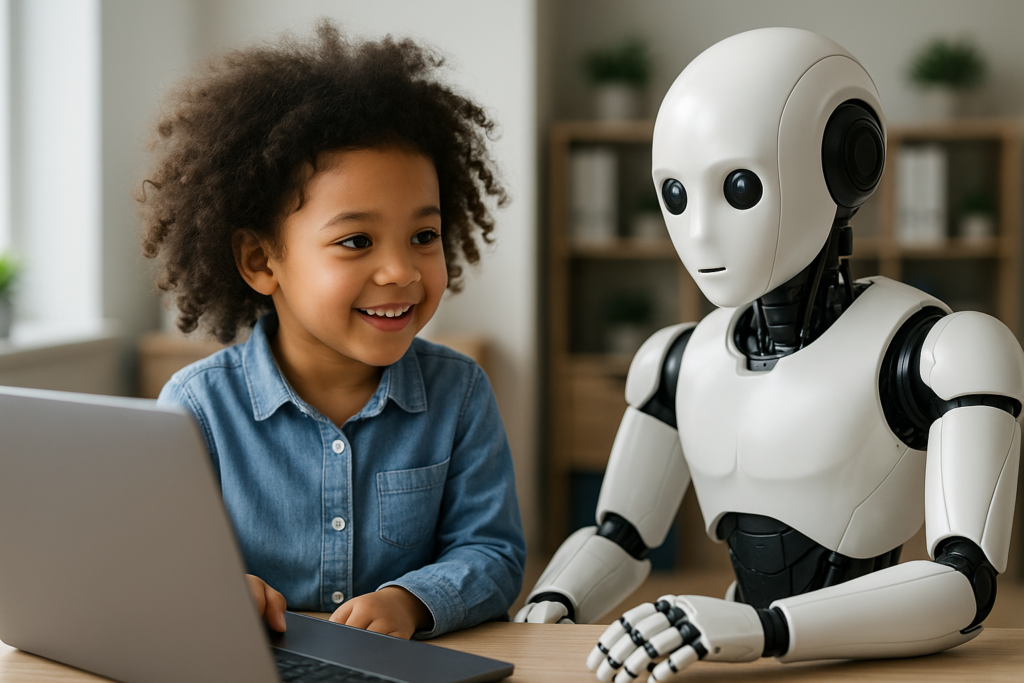
AI in child development offers new ways to observe, understand, and support children’s growth. With ethical design and proper alignment to developmental principles, AI tools can help detect subtle patterns, personalize learning, and foster better outcomes for children. This guide explains how to make informed decisions about AI use in child development, steps for practical implementation, and critical challenges.
What Are the Main Benefits of AI in Child Development?
AI-powered tools can analyze large and complex data from diverse sources, allowing researchers, educators, and caregivers to:
- Identify subtle developmental patterns that manual analysis might miss.
- Monitor growth using unbiased, repeatable methods.
- Create adaptive learning experiences tailored to individual needs.
- Detect early warning signs for developmental delays or challenges.
For instance, machine learning techniques allow developmental scientists to parse vast data from observation, questionnaires, and behavioral tracking to spot emerging developmental differences or strengths early, providing opportunities for intervention (PubMed: ML in ECD).
Ethical and Developmental Considerations
Applying AI in child development isn’t only about the technology. It’s vital to align with ethical practices and developmental science. Key considerations include:
- Ethical decision-making: Designing AI tools to support moral learning and fairness.
- Age-appropriate engagement: Ensuring that AI interactions suit the child’s developmental stage.
- Data privacy: Safeguarding children’s personal information from collection to analysis.
- Human oversight: Keeping caregivers involved in decisions and interpretations.
The principle of developmental alignment means that AI technologies should be created with an understanding of children’s cognitive, social, and emotional growth stages. Integrating psychology, ethics, and design improves effectiveness and minimizes risks (Springer: Developmentally aligned AI).
How Machine Learning Supports Early Monitoring
Machine learning (ML) is especially powerful in early childhood research. Its practical uses include:
- Analyzing patterns from developmental assessments and daily activities.
- Detecting deviations from typical growth trajectories.
- Suggesting personalized interventions or adjustments to learning plans.
However, researchers stress that ML tools aren’t a replacement for qualified professionals. Instead, they offer additional insights for early-stage monitoring—making your interventions more targeted, not automated decisions (PubMed: ML in ECD).
| AI Application | Benefit | Consideration |
|---|---|---|
| Data-driven screening | Uncovers subtle patterns | Requires specialist review |
| Adaptive learning | Personalizes feedback | Needs age-appropriate content |
| Predictive analytics | Flags early risks | Not a diagnostic tool |
| Behavioral analysis | Tracks progress over time | Protects data privacy |
Incorporating Embodied Learning and Ethics
AI’s value in child development isn’t just in crunching numbers. It can help teach children about technology and ethics. Research shows that embodied learning—using activities that engage both mind and body—can enhance children’s ability to make considered ethical decisions when interacting with AI systems (Springer: Embodied Learning and AI Ethics).
For instance, children participating in activities that involve physical movement and reflection around ethical dilemmas showed improved ability to inhibit impulsive actions and internalize moral lessons. This approach is promising for early AI education and fostering greater agency in young learners.
Steps to Thoughtful Implementation
- Set clear goals: Define what you want to monitor or achieve using AI (e.g., detecting language delays, personalizing learning).
- Choose evidence-based tools: Use AI solutions vetted by developmental experts and with documented educational outcomes.
- Integrate ethical guidelines: Ensure tools are designed with fairness, transparency, and the child’s best interests in mind.
- Engage humans in the loop: Professionals or caregivers should always interpret AI findings and make final decisions.
- Regularly review and adapt: Monitor the impact and update your tools or approaches as children’s needs change.
Checklist: Safe Use of AI in Child Development
- Have I reviewed the evidence supporting this AI tool?
- Is the tool developmentally appropriate?
- Are privacy protections in place?
- Do humans remain involved in analysis and decisions?
- Is the system designed with fairness and transparency?
Illustrative Example: AI-Assisted Language Screening for Preschoolers
Assumptions: A preschool wants to identify children who may be at risk for language delays using an ML-based tool that analyzes classroom audio recordings.
- The tool reviews speech patterns and vocabulary diversity for 30 children.
- Three children’s results are flagged as atypical.
- A specialist cross-references AI findings with teacher observations and a standard assessment.
- Two children are referred for extra support; one requires no intervention after follow-up review.
This process demonstrates ML’s utility for early detection and personalized intervention, while underscoring human oversight at every step.
Limitations and Uncertainties
Despite progress, AI in child development has limitations:
- Potential for bias if data is unrepresentative.
- May not capture the full complexity of individual children’s experiences.
- Overreliance on technology can reduce personal engagement or misrepresent findings.
- Many tools are still experimental and lack robust long-term outcome evidence (PubMed: ML in ECD).
Where to Learn More
For a deeper look at challenges and real-world use cases, visit:
- Ethical AI child development: A Practical Guide
- AI in Parenting: Debunking Myths and Unlocking Learning
- Emerging Tech for Child Development in 2026: Practical Wins
Next step: If you’re considering introducing AI-based assessment or support tools, begin by evaluating evidence, ensuring developmentally appropriate design, and prioritizing transparent oversight by professionals. Periodic review with input from stakeholders will help ensure positive outcomes for child development.
Sources and further reading
- Application of machine learning in early childhood development research: a scoping review – PubMed
- The impact of embodied learning activities on young children’s AI ethical decision-making: a study based on the stroop task | AI, Brain and Child | Springer Nature Link
- Developmentally aligned AI: a framework for translating the science of child development into AI design | AI, Brain and Child | Springer Nature Link

Pingback: Ethical AI child development: A Practical Guide
Pingback: Emerging tech child development: A Practical Guide