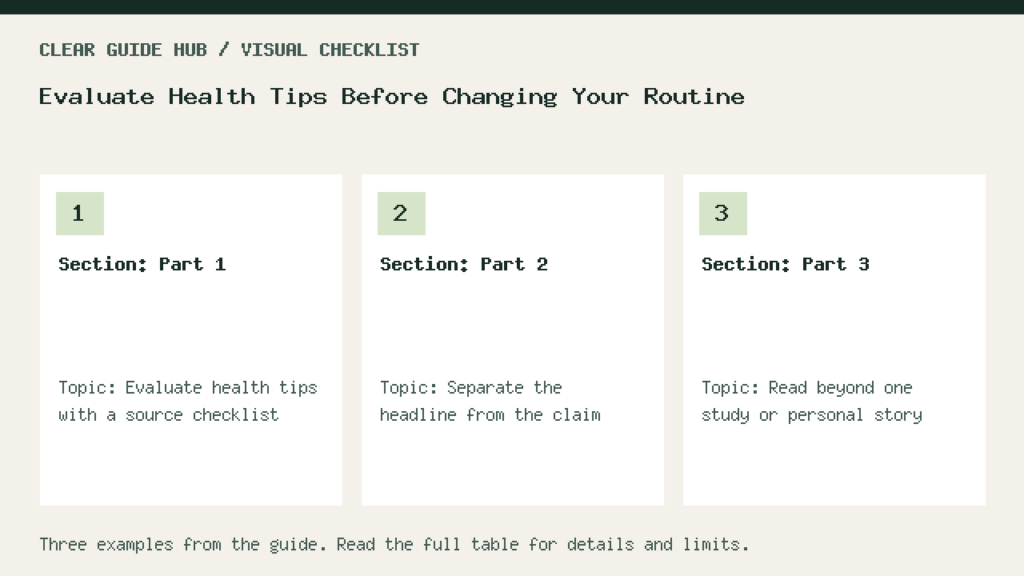
Evaluate health tips by checking who published the advice, what evidence supports it, and whether it applies to your situation. A celebrity name, a recent date, or a confident headline cannot answer those questions. Use the checklist below to decide what deserves further reading and what to discuss with a qualified clinician.
Evaluate health tips with a source checklist
Start with the page behind the social post or search result. Look for a named organization, author information, a review date, and links that support the actual claim. The National Library of Medicine tutorial explains how to assess the provider, purpose, information quality, and privacy of a health website.
| Check | What to record | Reason to pause |
|---|---|---|
| Publisher | Organization, author, and contact details | No identifiable source |
| Evidence | Research or guidance linked to the specific claim | Testimonials replace supporting evidence |
| Scope | Population and circumstances discussed | A finding is presented as advice for everyone |
| Timing | Publication and review dates | A new headline points to unrelated old material |
| Commercial interest | Products, sponsorships, or paid links | The only next step is a purchase |
Separate the headline from the claim
Write down one precise sentence describing what the tip promises. For example, does it claim that a habit improves sleep, that a supplement treats a condition, or simply that a study is investigating a question? Those are different statements. Next, follow the cited link and check whether it supports that same statement.
Also inspect the publisher’s purpose. A commercial site may contain useful material, but a sales incentive matters when you evaluate health tips. NIH’s Office of Dietary Supplements offers questions about responsibility, funding, evidence, and the reliability of information received online.
Read beyond one study or personal story
A personal success story does not show what will happen for another person. Similarly, a research headline may leave out important limits. Check what was studied and avoid turning a preliminary finding into a treatment instruction. If the article does not explain these limits, locate a clearer explanation before acting.
Use a second independent reference rather than several sites repeating the same press release. NCCIH’s guide to online resources can help you judge health information and investigate complementary health claims. Save the original links so a clinician can review the same material.
Illustrative example: checking a wellness claim
Assumptions: A fictional social post says that a new supplement will improve everyone’s energy. It links to a shop and provides no study. This is a checking exercise, not a report of a tested product.
- Copy the exact claim into a note, without entering payment details or health information.
- Find the publisher’s identity and any relationship to the seller.
- Ask which ingredient, dose, study, and population the claim concerns.
- Look for an independent explanation from a public health or research organization.
- Mark missing evidence as unresolved. Do not fill the gap with testimonials.
- Bring questions about benefits, interactions, and suitability to a qualified clinician or pharmacist.
The useful result is a clearer list of uncertainties. This exercise does not establish that the product works, that it is safe, or that it is appropriate for a particular person.
Keep a short evidence note
For each tip, record the claim, source URL, review date, evidence link, and unanswered questions. Add a separate line for the action you are considering. Keeping the claim and the proposed action separate makes unsupported leaps easier to spot.
If a message also asks you to sign in or provide account information, use our guide to checking an email link without visiting it. Do not send medical information through an unfamiliar link.
Evaluate health tips as information to investigate, not as a personal treatment plan. Before changing medication or starting a treatment, consult an appropriately qualified professional. Your next step is to check one specific claim with the table above and write down what remains unknown.