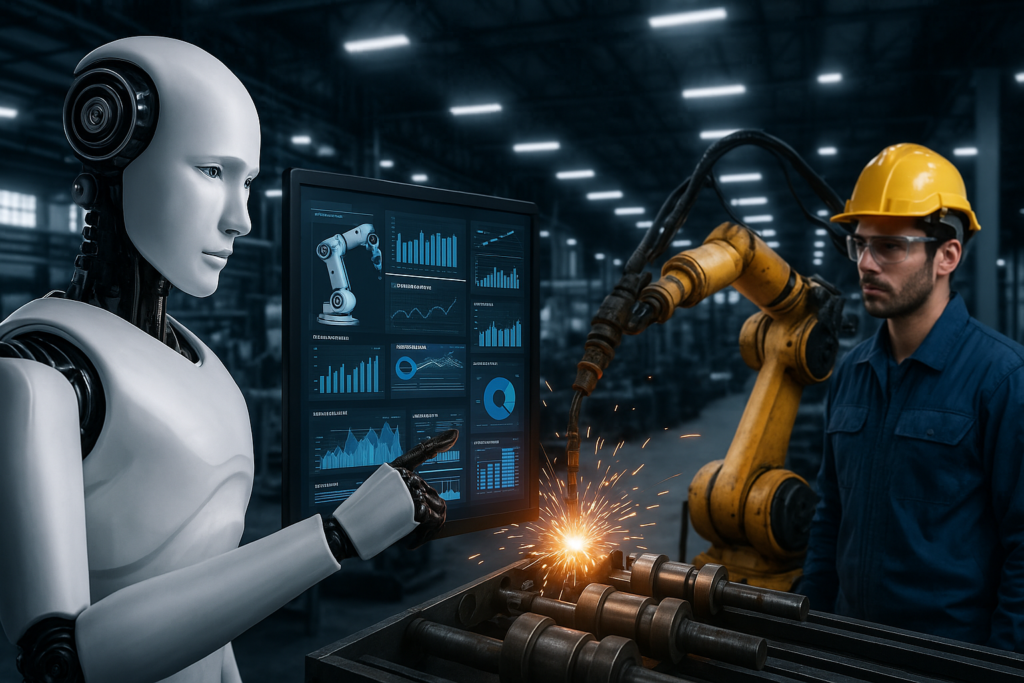
AI in manufacturing is enabling smarter, faster, and more reliable production by automating process modeling, optimizing system operations, and enhancing quality control. This practical guide explains how to apply AI in manufacturing, what to consider, and where industry guidelines and standards can help you take effective steps.

What Is AI in Manufacturing?
Artificial intelligence (AI) in manufacturing refers to the use of advanced algorithms, data analysis, and automation to solve real-world production challenges, from design to quality assurance. Its scope spans predictive maintenance, process optimization, defect detection, and integration with human workers for safer, more adaptive systems (CIRP Annals).
Key Practical Applications of AI
Manufacturers are deploying AI across several domains. Here are the most impactful areas:
- Process modeling and simulation: AI predicts how changes affect output, helping plan efficient production lines.
- Quality assurance: Machine vision and analytics detect defects and ensure product consistency.
- Predictive maintenance: AI forecasts equipment issues, reducing downtime and repair costs.
- Production optimization: AI dynamically adjusts schedules and resource use for greatest efficiency.
- Human-AI collaboration: Systems guide or augment human operators for safer, higher-quality results (NIST).
Practical Steps to Implement AI in Manufacturing
Moving from concept to reality requires planning. Here are actionable steps for factories considering AI integration:
- Assess current pain points. Identify repetitive, error-prone, or resource-intensive processes.
- Engage with industry standards. Use guidelines from reputable bodies like NIST and ISO to benchmark requirements and performance (NIST).
- Select use cases for pilot projects. Start where AI’s impact can be measured clearly, such as defect detection or maintenance scheduling.
- Prepare quality data. Successful AI relies on accurate, labeled data from sensors, images, or logs.
- Partner with solution providers. Consider collaborations with technology vendors or research institutes for tailored solutions.
- Develop metrics and monitor results. Use benchmarks to evaluate if AI meets defined operational goals.
Checklist: Getting Started with AI in Manufacturing
| Step | Key Action | Considerations |
|---|---|---|
| 1. Pain Point Analysis | Map manual and bottleneck areas | Where do errors or delays recur? |
| 2. Standards Review | Consult NIST/ISO frameworks | Compliance and benchmarking |
| 3. Use Case Selection | Choose pilot areas | Feasibility and ROI potential |
| 4. Data Preparation | Aggregate and clean data | Quality and accessibility |
| 5. Partner Engagement | Find tech/research partners | Experience and support |
| 6. Metrics Definition | Set clear success KPIs | Quantifiable improvements |
Decision Criteria: Is AI Implementation Right for You?
AI solutions are not one-size-fits-all. Consider these criteria before deciding to proceed:
- Data availability: Do you have enough data to train and validate AI models?
- Problem measurability: Can you define what success looks like in objective terms?
- Scalability: Is the solution feasible for your entire production line or plant?
- Compliance: Will the implementation meet relevant quality and safety standards?
Illustrative Example: Choosing an AI Use Case for Predictive Maintenance
Assumptions: A manufacturer operates five CNC machines and seeks to reduce unplanned downtime by implementing AI-driven predictive maintenance.
- Pain Point: Maintenance logs show average unexpected downtime is 20 hours per month, costing $500/hour.
- Data: Sensors collect temperature, vibration, and operational status every minute (sufficient for analytics).
- Use Case Selection: Predictive maintenance chosen due to clear historic costs and available data.
- Pilot: AI model is trained using the past 12 months of sensor and maintenance data.
- Results Monitoring (hypothetical): Within three months, unplanned downtime is tracked for measurable reduction, and costs are compared against prior months.
Standards and Best Practices
Reference industry best practices when adopting AI. NIST provides benchmarking, metrics for human-AI team efficiency, and helps shape global standards. The European Union’s coordinated plan outlines policies and strategies for AI deployment across manufacturing sectors (OECD).
- Follow established measurement and safety guidelines.
- Benchmark AI performance against defined standards such as NIST and ISO recommendations.
Limitations and Considerations
While AI in manufacturing offers many benefits, there are challenges:
- Data challenges: Insufficient or low-quality data limits AI accuracy.
- Integration: Legacy equipment may need upgrades for IoT connectivity and data capture.
- Skill gaps: Staff may require training to deploy and maintain AI systems.
- Standards evolution: Standards and best practices, especially for human-AI teaming, continue to evolve (NIST).
Next Steps for Manufacturers
If you are ready to get started with AI in manufacturing, analyze your highest-impact processes first, review relevant standards, and set up a pilot project with clear success metrics. For deeper background and real-world case studies, explore:
- AI state of the art in manufacturing (CIRP Annals)
- NIST AI for Manufacturing Initiative
- OECD report on EU AI manufacturing progress