
This work-life balance guide gives remote workers a 10-step plan that produces a reusable one-week routine, a boundary script and a simple checklist to set hours, workspace, breaks and communication rules.
Scope and prerequisites
Scope: practical, non-technical steps for individual remote or hybrid knowledge workers (home or coworking workspace). Do not use these steps to replace clinical advice for diagnosed mental health conditions or to change employer policy without approval.
Prerequisites: basic calendar and messaging tools (calendar, email/chat), ability to set and share working hours with your team, and a quiet work area or dedicated corner.
10-step checklist (follow in order)
- Define and publish work hours. Pick core hours and add them to your calendar with clear free/busy status. Output: shared calendar showing your availability for the week.
- Create a short boundary script. Write two 1–2 sentence templates: one to set expectations with your manager and one for family/household. Output: two saved templates in a notes app or message draft.
- Designate a dedicated workspace. Choose a consistent spot and set three essentials: reliable internet, ergonomic seat, and a small checklist for lighting/noise. Output: a photographed checklist left at the workspace.
- Time-block your week. Assign 90–120 minute focused blocks for deep work and label them in your calendar. Output: calendar with color-coded blocks for tasks and meetings.
- Plan regular short breaks. Schedule a 5–15 minute break every 60–90 minutes and a full lunch break (30–60 minutes). Output: visible micro-break events in your calendar.
- Use technology guardrails. Mute notifications outside core hours, and set an email check cadence (e.g., twice daily). Output: notification rules and an email-check reminder.
- Stay socially connected. Add one weekly 15–30 minute non-work touchpoint such as a virtual coffee or check-in. Output: recurring social event on calendar.
- Review workload weekly. Use a 10–15 minute Friday check: mark three items to carry forward, delegate, or defer. Output: a prioritized 3-item carry-forward list.
- Protect mental and physical health. Book one weekly physical activity and one short daily mindfulness or stretch break. Output: recurring calendar events for exercise and a daily stretch reminder.
- Escalate when needed. If recurring overload or isolation persists, use your manager or HR channels and request ergonomic or mental-health support. Output: documented request and next-step response date.
Expected output and how to check success
- Concrete outputs you should have within one week: shared calendar with hours and breaks, a workspace checklist, two boundary message templates, and a one-page weekly priorities list.
- Quick success checks: fewer after-hours messages, at least three completed focus blocks per day, and at least one social touchpoint scheduled for the week.
Common failure cases and fixes
- Failure: Colleagues ignore your published hours. Fix: Use an explicit one-line calendar event description and follow up with manager to align meeting windows.
- Failure: You can’t stop checking messages. Fix: Disable notifications outside work hours and set two fixed inbox-check times.
- Failure: Workspace disruptions (noise, poor ergonomics). Fix: Move to alternate quiet location, add inexpensive ergonomics (external keyboard, cushion), or request employer equipment per company policy.
- Failure: Persistent isolation or signs of burnout. Fix: Contact your manager or workplace health resources and request manager training or employee support — see WHO guidance on telework risks and employer measures for details.[WHO telework brief]
One-week remote work worksheet
Filled worksheet to implement the guide — hypothetical example labelled.
| Item | Action | When | Expected result |
|---|---|---|---|
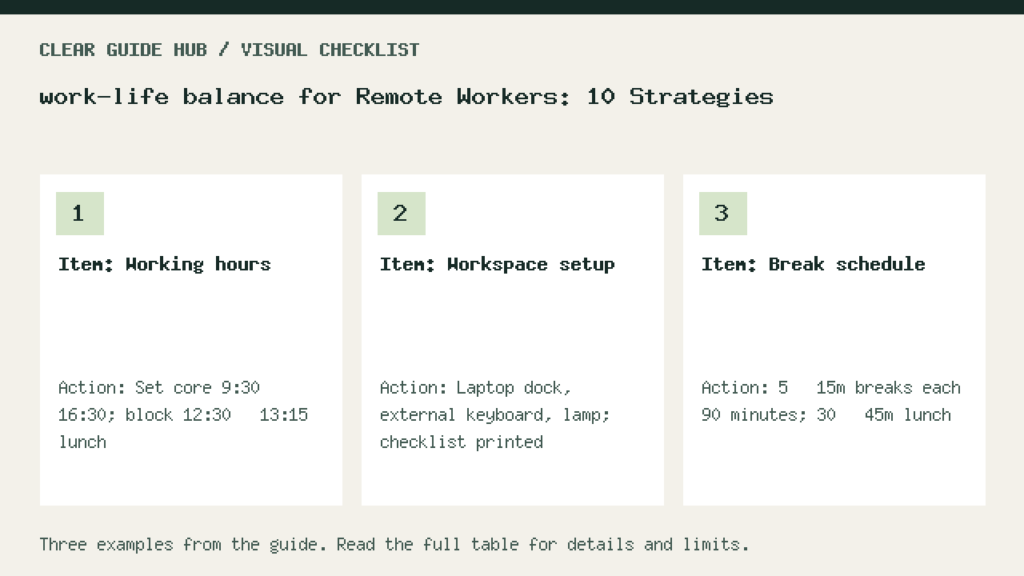
| Working hours | Set core 9:30–16:30; block 12:30–13:15 lunch | Mon–Fri | Shared calendar shows busy hours |
| Workspace setup | Laptop dock, external keyboard, lamp; checklist printed | Today (hypothetical) | Comfortable desk with checklist visible |
| Break schedule | 5–15m breaks each 90 minutes; 30–45m lunch | Daily | Breaks appear as calendar events |
| Communication rules | No Slack after 17:00; two email checks daily | Start immediately | Fewer after-hours messages |
| Wellbeing check | Weekly 10m review Friday; one exercise session | Weekly | Prioritized carry-forward list |
Evidence-backed points to remember
The World Health Organization and the International Labour Organization note benefits of teleworking (flexibility, commuting time saved) and warn about risks including isolation, burnout and musculoskeletal issues. Employers should provide equipment, training and establish the right to disconnect; occupational health services can offer ergonomic and mental health support.[WHO telework brief] [WHO mental health guidelines]
Next action
Pick one step from the 10-step checklist and implement it today (for example: add your core hours to your calendar and save two boundary message templates).


Pingback: Explore Ohio Governor Race 2026 Insights: Implications Ahead - Clear guide hub
Pingback: Unlock Peak Performance: 10 Essential Remote Work Productivity Tools for 2023 - Clear guide hub